

12·
3 months agoI only know the word as a derogatory term and have no idea who you are trying to offend with that.
I only know the word as a derogatory term and have no idea who you are trying to offend with that.
What exactly lead you to believe it serves an M3U file?
Even if you had good intentions with that, throwing common solutions that obviously won’t work at someone only leads to them wasting time. It’s not a good thing to do.
Well, it’s using funny JS, you learn how it works and trick it into downloading the fragments.
But why would you bother doing that if the movie is available on public trackers in better quality?

x86 is the instruction set, 64 is for 64-bit extension of that instruction set. It’s also known as AMD64 to make it even more confusing. All Intel Core processors starting from Core 2 are using that architecture, as far as I remember.
By “tinkering a bit” I meant sometimes digging up a package in the archives and rolling it back. I used Arch daily for around 2 years and had to do it once. You can also avoid it by keeping tabs on what the community says, broken packages cause quite a bit of fuss.
Release schedule is a trade off, if you are updating weekly, it’ll usually take less than 5 minutes to download all the packages that got updated within that week. The rarer you update, the more time each update takes.
But it’s all ultimately a matter of preference, just wing something up and try to use it for a couple of days. If it’s not to your taste, scrap it and try something else, it’s rare to end up with a setup you like right from the get go.
Some distributions like Debian get releases once per year or two, people tend to joke around that those are “stale” rather than “stable”. Fedora lives somewhere in between, you get more testing than on Arch, but less than on the likes of Debian. Usual Fedora release cycle is once in half a year.
By old Mac hardware I assume you mean x86-64 Intel Macs? Pretty much any modern distro should work on that.
If you are in general ok with tinkering a bit with your computer, I’d recommend Arch derivatives like EndeavourOS or CachyOS, these come with full GUI installers and software availability on Arch is one of the widest around.
Arch is rolling release, though, meaning each package gets updated as soon as a new version is available, rarely it leads to things breaking.
If you want something more stable, Fedora is a great choice, too.
As you mentioned yourself, Mint also exists. It’s packages are usually on the older side, but the distro itself is trying to be this “gateway drug of Linux”.
The feel of the system is mostly determined not by your distribution, though, but rather by your desktop environment. As far as I know, GNOME is the most “Mac-like” out of popular ones. KDE is “Windows done right”, and there are a lot of other options, but you’ll mostly have to try them out yourself until you find something you like.

The urge to downvote something you really shouldn’t have never been so strong.
I have this handy little bash function, I think you should use it.
get-english-ordinal-ending() {
  case "$1" in
    *11 | *12 | *13) printf 'th' ;;
    *1) printf 'st' ;;
    *2) printf 'nd' ;;
    *3) printf 'rd' ;;
    *) printf 'th' ;;
  esac
}
We don’t care, we are too busy compiling our systems.
The party trick of NixOS is declaring your whole system in a huge config file. If you want someone to get the same system, you just throw your config at them and it works*.
Well, it’s because the whole column is fullscreened instead of a single window in that case. I guess you can abuse it a little bit and write a script that’d switch the column into tabbed mode before fullscreening a window if the column has more than one window in it.
I don’t think there is a way to know if the column is already tabbed, though. Might need a bit of unholy incantations to make it all work.
Niri’s workspaces are just rows, windows being expelled from the columns when fullscreened is very much expected.
I suppose what you want is floating the window and making it fullscreen, returning it to it’s position in the layout after returning it to it’s normal size?
To be honest, sounds like a bit of pain to implement.
The coffee one is not correct, vertical katakana should have vertical ー, the same mistake is across the rest of the ad, it also says バン instead of パン.
寿司屋 is technically correct, but you’d never see that on a sign, it sounds more like a description of a place rather than an ad sign, if you know what I mean.
中古 is written like 古中 for some reason? The text under (above) it is barely legible, whatever I can make out of it is just random characters somewhat related to 中古, like 品 or 料, but I can’t string it together into something that’d make sense.
…
Did what I probably should have done from the very beginning, looks like this is the source and it came to be before slop became common. The person who made this has clearly used something to generate it, the sheer quantity for the timeline is kind of insane, but they were probably using the old tools.
What’s up with the text in the wallpaper? I’d think it’s slop, but it looks as if someone deliberately made it look borked.
I might have slipped up on my way here, but I’m happy with how it turned out.

It’s so hot outside, I wish I could go to Antarctica to cool off with penguins… Did you know Linux logo is a penguin?
No matter how bad the content is, I don’t think anything deserves the terrible fate of being put on Facebook.
I absolutely love my bland rectangles with text. Never changed my Waybar theme and I have no rounding on my windows. It’s my 15 corner pixels of screen real estate, go away with your fanciness.

The very idea that stealing someone’s ID or forging it can be even remotely related to digital piracy is egregious and should not be considered for discussion in this community.
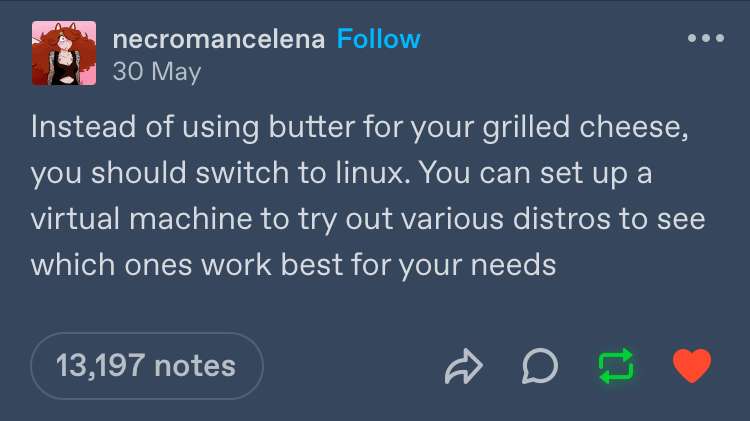
Nah, their instance is blocked on mine.
Not the first time I see this, I guess it’s time to either host my own instance or find one with less righteous admins.