
I did. All the important things have time to gracefully shutdown now. (Except my for my rack of 4 DL360’s, which need something a little more robust than a Walmart UPS. They aren’t critical and only exist to handle weird one-off projects anyway.)

- 0 Posts
- 52 Comments
Joined 3 years ago
Cake day: August 15th, 2023
You are not logged in. If you use a Fediverse account that is able to follow users, you can follow this user.
This happens, too. A burst of local brownouts killed an OPNsense firewall of mine once. (The hardware was fine. The data got wrecked.) The firewall would boot, or almost finish booting, and then another brownout would hit. After the third or fourth cycle, the poor thing was toast.
I should thank the power company for free resilience testing.
 20·5 months ago
Most of this is just marketing crap from Anthropic.
Finding vulnerabilities in code and generating complex, multistep exploits with publicly available models is possible now. This biggest hurdles now is setting correct context and actually knowing what to look for. Any “guardrails” for this behavior are easily bypassed by framing the detection and exploit generation as a valid dev style question in the most difficult of situations.
They likely just trained a model without guardrails in this case.
What they are doing here is over-hyping a problem and framing it like they are the only ones with a solution. LLM security issues are more in-focus now that companies have dumped a ton of resources into building AI systems they don’t really understand.
Companies these days do what is right for their shareholders and if Claude makes money, or appears to make money, then the shareholders are happy.
 2·11 months ago
Do a look-through of that XML folder as well. Images could be base64 encoded in those XML files. I remember several instances where XML was used as a template “language” for old style GUIs. (When XML and HTML diverged, a lot of that kind of thing was happening.)
There are some kind of instructions in this video that go through a logo change process. I don’t know if this helps, but I tried: https://youtu.be/QrobPTgu7C0
Also, does it use some kind of database? The images seem like they would be small enough to jam into a blob and just store alongside regular inventory information. If there is a database, it’s probably third-party. If it’s third-party, I would see if it had its own installer packaged inside of the application installer itself. (A third party database would likely be outside of the main app folder.)
Just dumping random thoughts.
I think a conversation about Hannah Montana Linux could be quite entertaining.
I don’t want to go so far as to tell you how to think, but as long as we are talking about how to visualize IP addresses, you may want to check out subnets and subnet masking.
The notation of IP addresses starts to make sense when you think about the early days of TCP/IP when all IP addresses were public and NAT’ing wasn’t really required yet. Basically, there needed to be ways for networks to filter traffic by IP blocks that were applicable. (It was [in part] a precursor to collision avoidance, but absolutely not the full story.) We still use addressing and masking today, but it’s more obvious when it’s local. (Like in data centers, where it’s super practical to mask off a block of addresses for a row or rack of servers.)
To your point, yeah. IP addresses are probably more comparable to the Dewey Decimal System rather than actual numbers and thinking of them as strings is probably easier.
255
Small correction, but an important one: 0 is a number too.
In terms of IP masking and broadcast addresses, the max is 255.255.255.255
For those who are still confused, ping works with 32 bit unsigned integers. While there certainly are more uses, it’s a much more convenient method for storing IP address in a database as it’s easier to sort and index than 4 numbers separated by 4 periods
http://www.aboutmyip.com/AboutMyXApp/IP2Integer.jsp?ipAddress=1.1.1.1
This has been a thing for years now. While I am sure it might annoy some pirates, it’s likely aimed at easily executed malware.
I deal with spam filtering on a daily basis and about 90% of it originates from Gmail. Most of that is just fishing/fraud. It would really suck if my users could easily detonate malware attachments, so this Gmail policy is a good thing for me.
Wustite, ferrous oxide, is black. FeO.
Typical rust, usually found as hematite, is Fe2O3 and is red/brown. Also an iron oxide.
Magnetite is also another black iron oxide, Fe3O4.
There are quite a few other flavors of iron and oxygen too.
 42·1 year ago
“the gays” in Russia:

Sorry if it sounded like my rant was directed at you as it absolutely wasn’t. Your comment triggered me, because I absolutely fully agreed with yours as well. ;)

setenforce 0is much cleaner, I have found.
Its just complex
When a security mechanism becomes more complex to manage than what it is supposed to protect, it becomes a vulnerability itself.
If you had a minimal system that you built from the ground up yourself and wanted to only have that system function in very specific ways, SELinux would be perfect. I would go so far as to say it would be nearing perfection in some ways.
Sorry, but in the real world, ain’t nobody got time for that shit. If you use auto configuration tools or pre-canned configs for SELinux on a system you are unfamiliar with, it’s more likely to cause application issues, create security gaps and will likely be shut off by a Jr. admin who really has no fucking clue what he is doing anyway.
It’s just easier to keep your system patched and ensure basic network security practices anyway.
It’s not impossible to manage these days. In the early days it was, but most everything is automagic now. If I am not mistaken, SELinux can be enabled to ‘log only’ which would give you data better handled by a HIPS anyway. (Don’t quote me on that.)
You want me to do what now?
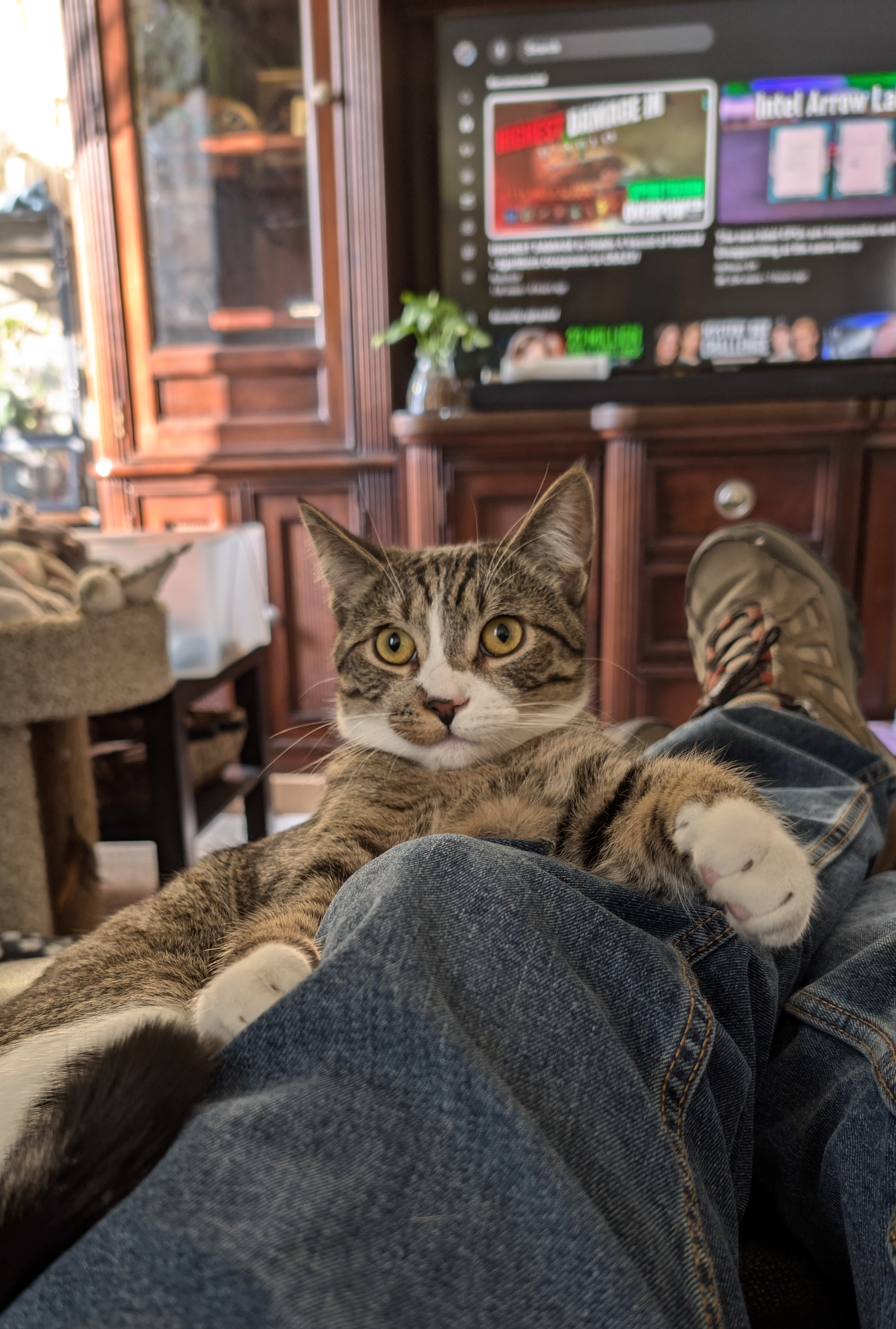
(Sudo, the cat.)
“I was training my AI on porn.” Problem solved.
Flags have always been poorly standardized outside of system apps and tools. Generally, -u should equal --update (and depending on how the app was written, may warn for --up: “Did you mean --update?”) Single tick flags are generally combinable: -ua or -ls. I have seen long single tick flags somewhere, but can’t remember where. (Your -update example.) Various python libraries than handle flags have helped a ton with getting people to use the same patterns, so that is nice.
You just summed up my first experience with systemd many years ago.
systemctl != sysctl. Both somehow got wedged into the same index in my brain and took years for me to correct. On top of that, <service> <action> was reversed to <action> <service>. (Or was it the other way around?)
I was convinced from my first experience with systemd that the person who wrote it was the purest form of evil. (It’s leveled out a bit over the years, so it’s tolerable to use these days. Still not a fan though.)