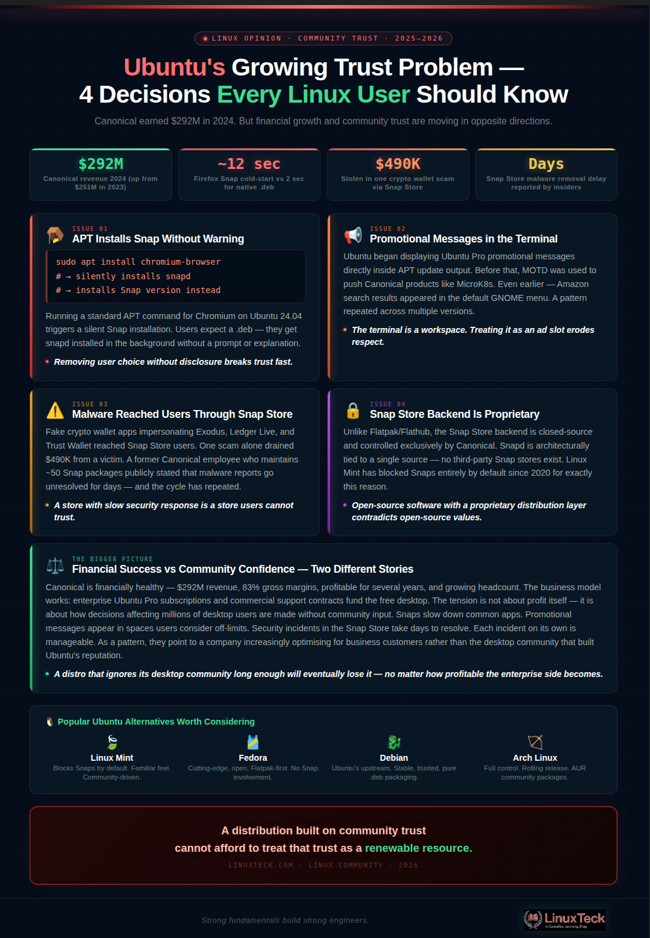

I believe the community had expressed a lot of valuable ideas here, so I will keep the post. But I am locking the thread because it’s just not information given in good faith. That’s not to say that the points are all wrong, these can be debated. And we did debate. But the infographic itself is border to being just propaganda against a distro that serves well to a lot of users (this is a fact! even if me or you think those users could be served better.)
If anyone else would rather read text as text: https://www.linuxteck.com/ubuntu-trust-problem-2026/
Appreciate it as a mobile user!
Thanks :)
Strong agree. I use a derivative that blocks snaps instead of direct Kubuntu now, and it wasn’t Just because of the snaps.
I use a derivative
Without Ubuntu Pro subscription the entire Universe repository does not receive any security updates by Canonical:

https://canonical.com/blog/ubuntu-pro-enhanced-security-and-manageability-for-linux-desktop
You should consider switching to an entirely independent distribution that does not lock security updates behind a paywall, perhaps something based directly on Debian or Fedora.
Update: Correction. While you do get five years of security updates for Universe on an Ubuntu LTS, those are updates done by the ubuntu community, not canonical. To get Universe security updates from Canonical, you do have to sign up to Ubuntu pro, which can be done without any payment, but as I describe in my original comment, does require creating an account.
While Canonical deserves the criticisms leveled by op (that I agree with), it’s also incorrect to say that they lock security updated behind a paywall.
Anyone that does use Ubuntu gets security updated until they stop supporting that particular release version, which iirc is for six years (I may be wrong, thus is from memory).
If you want extended security updates for a specific version of the os, you can elect to sign up to Ubuntu pro without paying any money. You do have to make an account, and if you so choose you can populate the account info with garbage info and a disposable email, and you’ll get extended security updates for that release version.
While Canonical deserves the criticisms leveled by op (that I agree with), it’s also incorrect to say that they lock security updated behind a paywall.
Anyone that does use Ubuntu gets security updated until they stop supporting that particular release version, which iirc is for six years (I may be wrong, thus is from memory).
I quoted the relevant part and yet you still don’t understand that Universe is explicitly not covered by security support by Canonical without Ubuntu Pro.
Ah. Both misunderstood what you were saying and was uninformed. My apologies. Editing my original comment to reflect that.
you can elect to sign up to Ubuntu pro without paying any money
you can elect to sign up to Ubuntu pro without paying any money
Yes, home users can sign up for Ubuntu Pro for free which means repository access is tracked on an account level. How isn’t this more shitty than for example plain Debian?
Debian also doesn’t offer security upgrades for contrib and non-free.
Only main is officially supported.Same as Ubuntu, security upgrades for additional repos are handled by the community, not the distro maintainers themselves.
Debian also doesn’t offer security upgrades for contrib and non-free. Only main is officially supported.
So Fedora and openSUSE are most superior. OK.
Drink your verification can to install security updates.
The updates available through Ubuntu Pro wouldn’t have normally been available prior to Pro. It’s an added service, not something that was previously available that is now locked behind a paywall. There are plenty of reasons to not like Canonical but this isn’t one.
It’s an added service, not something that was previously available that is now locked behind a paywall.
I didn’t say anything about it having changed, so your “now” is disingenuous. Fact is, update support by Canonical for Universe is locked behind Ubuntu Pro. Non-Ubuntu distributions such as CachyOS/Fedora/Bazzite/openSUSE/Debian/… don’t have this hostile behaviour.
They also don’t provide those updates. I am a Fedora guy by the way. I’m not defending Canonical, just pointing out that this is a silly reason to dislike them.
They also don’t provide those updates.
Fedora allows all updates that do not break compatibility. To update packages in Universe means adhering to overly zealous version number freeze policy, whereas leaf packages in Fedora can be updates without much fuss. I contributed a small number (only two or three) of updates to Fedora packages years ago. Nothing was a core package, only tiny stand-alone utilities, so the stuff that would be in Universe under Ubuntu, but they had new version numbers. Updates were accepted by the maintainers without much trouble.
I am a Fedora guy by the way.
So you should know that I’m right.
Right, but if you’re after the level of “stability” that Canonical is offering, where are you getting it for free? Maybe there is another place but none that I’m aware of. I think it is perfectly fine for them to charge for that, especially if enterprise customers are the target audience and those who aren’t don’t have to pay for it.
Right, but if you’re after the level of “stability” that Canonical is offering, where are you getting it for free?
Fedora, Alma Linux, openSUSE Leap, LMDE,…
What’s a better alternative that uses apt and KDE and has relatively up-to-date packages (other than Debian testing)?
uses apt
May I ask why you seem to be married to the use of
apt?Just couldn’t pass up on the opportunity to insert this banger.Isn’t apt still better at resolving the dependency tree than other managers? (Idk if it is, but vaguely heard so.)
Linux mint Debian Edition, and just install KDE yourself ig, otherwise MX linux KDE
Debian Sid!
What’s wrong with Debian?
I already know about it, so there’s no need to tell me.
Fair enough.
There’s also Pop and Mint, though I don’t know if their update model differs from Ubuntu at all.
But if you’re already familiar with Debian, why not use it? It’s widely recommended for a reason, it’s hard to beat.
Pop!_OS uses COSMIC (a modified GNOME), not KDE.
Linux Mint uses Cinnamon (a modified GNOME 3) or MATE (a modified GNOME 2), not KDE.
The answer to “why not Debian” is that I try to install Debian first every time, but if it doesn’t work for whatever reason I grab Kubuntu instead of trying to troubleshoot it. 3 of the 4 desktop computers I’ve tried to install Linux on lately ended up with Kubuntu instead of Debian.
(For my personal desktop that tends to have a bleeding-edge graphics card at the time of building/installing, that’s understandable. For the other computers, for other members of my family who don’t need the latest and greatest, Debian’s failure to support several-year-old hardware – at least in the installation environment, without fiddling – was less forgivable.)
I’m sure you can install KDE on either of those.
I’m surprised Debian doesn’t Just Work for you though. I recently converted my laptop and desktop and had no issues.
Debian should be great on old hardware too. Longevity is part of their mission. The installation environent might be a bit tricky if you have really old or uncommon hardware, but in those cases I just pick the text installer, which has much fewer dependencies.
Its objective superiority puts others off.
Fedora offers apt. AFAIK not by default, so it has to be installed via dnf first but then it’s available.
It’s been like that for years.
https://www.google.com/search?q=why+shouldn't+you+use+apt+on+fedora&oe=UTF-8&hl=en-us&safe=active
It’s a really bad idea to have two package managers overlap (this is also why more “cross-system” package managers like nix and brew are okay: they consciously install to separate paths to avoid overlapping)
Fedora does not offer APT repositories, so if you somehow don’t overlap and pretty much exclusively use APT, you’re pretty much just converting your distro to Debian (or whatever’s providing your repos). In the forums we call this a Frankenstein; support is seldom given for raising the dead.
https://www.google.com/search?q=why+shouldn't+you+use+apt+on+fedora&oe=UTF-8&hl=en-us&safe=active
Is your answer whatever Gemini happens to hallucinate on a given day?
https://www.google.com/search?q=why+shouldn't+you+use+apt+on+fedora+-ai
do yourself a favor and just block the overview: https://www.reddit.com/r/uBlockOrigin/comments/1crc47m/is_it_possible_to_use_ublock_to_remove_googles/
Would MX Linux with KDE fit your needs?
It’s not KDE, but I think Linux Mint Cinnamon is a no-brainer for somebody who really just wants to use ubuntu.
However, as a long time Mint fan I recently had reason to switch to Debian 13 w/ KDE Plasma and it is pretty great.
Ubuntu Pro is free for personal use on up to five machines.
Also note that Universe is the community-maintained repository, sort of like the AUR but the community also reviews package creations. The Main repository is maintained by the Ubuntu Project and has always had free security updates.
Ubuntu Pro is free for personal use on up to five machines.
If you’re not paying for the product, you are the product.
Debian is free for any use for an unlimited number of machines without corporate tracking which packages you install.
If you’re not paying for the product, you are the product.
Debian is free for any use for an unlimited number of machines without corporate tracking which packages you install.
So I guess with Debian, you are the product.
Debian is a community, not a product.
Interesting. I can use a community for my OS? So every time I hear someone say “install debian”, they’re telling me to install a community?
Either way, it’s free, so I’m still the product.
Either way, it’s free, so I’m still the product.
it’s free, because people have decided to come together and volunteer to create something that is beneficial to them, allows them to express themselves, and distribute it for free to better other people’s lives and contribute to human existence. Part of their motivation to create such a thing is to not have the users be the product.
When there is a soup kitchen for homeless people, the homeless people are not a product.
I can use a community for my OS?
Debian is a community.
Debian GNU/Linux is a non-commercial Linux distribution, ergo not a product.
Client-side data collection is opt-in and open-source: https://www.zdnet.com/article/canonicals-ubuntu-telemetry/ If you’re talking server-side collection we don’t know about, I’d call for burden of proof since neither Ubuntu nor Debian have relevant history of collection and that would probably violate the Privacy Policy.
Client-side data collection is opt-in and open-source
You need to log in to use Ubuntu Pro. Obviously.
that doesn’t really change what I’ve said
I thought Debian was a community. How are you installing a community on computers?
lock security updates behind a paywall
Saying this is like screaming “I don’t know anything about Ubuntu except that I hate it!!!”
Saying this is like screaming “I don’t know anything about Ubuntu except that I hate it!!!”
I posted a screenshot from Ubuntu’s own blog. So they hate themselves and lie to the world?
It’s maintained by my hardware OEM (Tuxedo) and I’m not even sure it has Universe - most things are flatpaks.
I’m not even sure it has Universe
I strongly suggest looking it up.
Novel got Suse pretty stable now too. I’m still a Fedora fan but it’s an option.
deleted by creator
Maybe it was just me, but Kubuntu was also the least stable distro I’ve tried on my gaming laptop. Constant crashes and random reboots.
I’ve had zero issues with Mint.
I started out with Ubuntu a little over a year ago. Then came an update that removed the ability to change the brightness of my desktop’s monitor. Felt like an Apple move, so I gave Mint another go. Have really enjoyed it (though I’m starting to eye CachyOS since Mint has seemingly decided to comply in advance with the CA age-verification law–haven’t added anything yet, but say they will)
i still have a server running ubuntu
i run snaps on it ewwwww!
it has never fucked me over
why is this infographic AI generated and where are the pixels
The article: https://www.linuxteck.com/ubuntu-trust-problem-2026/
Thanks. I have to wonder if people became allergic to posting text that can be resized to my screen.
Although the site is also shit, on the phone the text column is like twenty characters wide.
Ironically, just read an article recently about this exact issue.
The article from LinuxTeck is AI generated. Not unlikely the itsfoss was used as inspiration or whatever since ot was posted the week before.
No prompt. No warning. No consent.
This was not a bug. It was a deliberate product decision.
Yeah… too many rhetorical devices. A human writer would notice that it’s getting a bit excessive.
arch
bow and arrow
is this from another dimension?
Is .gif different there?
All symbols are wrong, but in ways that oddly make sense:
- Mint - it’s a leaf.
- Fedora - it’s a wearable.
- Debian - the logo coils itself, so does a snake.
- Arch - arcus~arco~arc is “bow” in Latin/Romance.
I don’t know if what I’m going to say is correct, but this smells like LLM shitting emojis.
Seems in that place a Fedora is worn on the chest instead of head.
Snap is the cancer of Linux. Go work for Micro$lop if you like to disrespect users.
Why is fedora a tank top?
Is that what that is? I thought it was a grocery bag.
I think? Neither makes sense.
Yea, I dunno either. Would be nice if the image had a few more pixels… I tried zooming in and it didn’t help. My head was like, “it’s an ikea bag… because Fedora is all about Flatpak. And all the furniture at ikea is flat pack.” It’s a long logic trek I had to go to get there to be honest. Most of the others don’t make much sense either. Debian is some little dragon guy? Arch is a bow an arrow? Is is possible this image is an AI generated summary of the original article and it’s just guessing at what the logo should be for these different distros?
I suspect it’s just nonsense from the AI generator.
. . . and it all boils down to “Canonical being into rent-seeking and having weird NIH issues that make it push low-quality own software (snaps in the current iteration, but there have been others) over better solutions used by other distros.”
Original at https://www.linuxteck.com/ubuntu-trust-problem-2026/
I wondered why they didn’t mention that the Universe repository comes without any form of official support and that unpaid community members are expected to cherry pick bug fixes and backport them, usually resulting in no updates, a potential security risk.
Then I scrolled down and they’re suggesting Ubuntu derivatives that are also affected by this (Mint pop). I have the suspicion that they don’t mention to make these two look good.
See https://www.flu0r1ne.net/logs/ubuntu_withholding_universe_security_patches for a somewhat recent (2023) overview on that topic and how Ubuntu Pro plays into this.
This was always the case. Main and restricted were guaranteed by Canonical, universe and multiverse fully owned by the community. A bunch of paying customers were unhappy with not getting updates to universe packages, so Canonical made a separate repository that would do that for Ubuntu Pro. Community members with access to the universe repository can still upload fixes there.
This was always the case.
Yes, I know. So? Doesn’t change the fact that users of Debian/Fedora/… don’t have to sign up for a “Pro” service to get the same security updates.
ads in the terminal lol. back in 2009 I was a gentoo user and was distro shopping. looked at fedora Debian Ubuntu and arch and settled on Debian.
I don’t remember if ubunto had either snap or unity back then… but I saw Ubunto as mainly making Debian easier to use. I was coming from Gentoo… debian was already easy to use 🙂
now, I use arch btw. switched in 2019 (mainly cause I got new hardware and needed latest releases and latest bugs 🙂)
I don’t think snap existed in 2009?
But yeah Unity was the desktop iirc.Edit now I’m not sure about unity either.now I’m not sure about unity either.
Unity didn’t but its predecessor Netbook Launcher did.
Too many pixels
Company gonna company. Switch back to Debian and realize most of what Ubuntu did was copy Debian and allow for non free drivers.
Ubuntu was always just a broken Debian with marketing. Just like Mandrake and Red Hat. Except it was successful marketing this time.
There were a few good things. LTS and PPA.
Oh how I hated it when I experienced the snap shenanigan firsthand.